

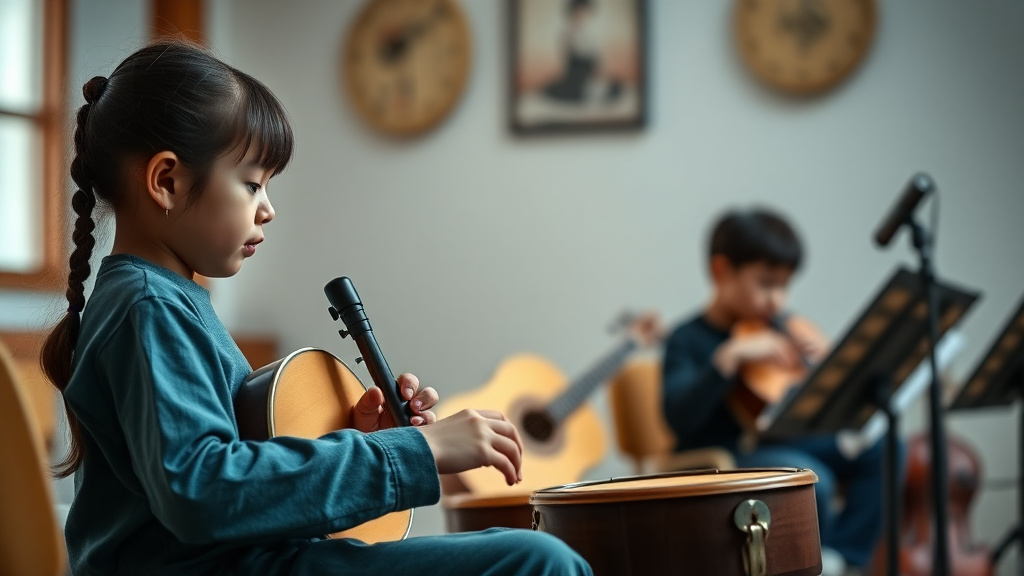
While many guardians face challenges discovering the right educational programs for their children, a expanding collection of research reveals an remarkable discovery: classical music education. Far beyond simply entertaining young minds, professional music education has been shown to improve mental functions, boost educational outcomes, and cultivate emotional understanding. This article explores the strong research behind classical music programs, analyzing how exposure to composers like Mozart and Bach can shape neural development, enhance focus, and develop dormant talents in children during their critical formative years.
Cognitive Development and Academic Performance
Classical music education has emerged as a significant force for intellectual advancement in children. Research demonstrates that students involved with formal music instruction show substantial gains across various mental areas, including memory, attention span, and problem-solving abilities. The organized framework of learning classical music requires children to build dedication and mental clarity, skills that effectively translate to academic settings. These neurological enhancements create a basis for exceptional results in all academic subjects.
The educational benefits of classical music education extend far beyond the music instruction setting itself. Students involved in intensive music training routinely demonstrate improved standardized test results and sustain stronger overall grade point averages relative to their non-musical peers. The relationship between musical instruction and academic success demonstrates how music instruction strengthens executive functions, enhances working memory, and enhances processing speed. These cognitive improvements prepare musically trained students for ongoing educational achievement during their educational progression.
Advanced Math Abilities
The relationship linking classical music and mathematical ability has been well-established in educational research. Music theory fundamentally involves mathematical concepts such as proportions, sequences, fractional values, and ordering patterns. When children begin reading music notation and understand rhythm structures, they concurrently build numerical reasoning abilities. Studies demonstrate that students with music training display stronger results in geometry, algebra, and abstract mathematical thinking, suggesting that musical instruction provides unique cognitive pathways for mathematical comprehension.
The spatial-temporal mental processing developed through classical music training shows especially beneficial for mathematics achievement. Learning to master an instrument necessitates children to mentally process spatial relationships and temporal sequences, skills immediately relevant to mathematical solution development. Research indicates that music students perform substantially better on standardized mathematics assessments, with improvements especially marked in complex problem-solving scenarios. This connection highlights how classical music education develops the precise cognitive architecture required for mathematical excellence.
Advanced Language Processing
Classical musical training markedly strengthens language processing capabilities in developing children. The auditory discrimination skills necessary to identify musical pitches, tones, and rhythmic patterns strengthen the corresponding neural circuits involved in phonological awareness and language understanding. Children trained in music show better reading skills, increased word knowledge, and strengthened phonological abilities. These language benefits result from musical instruction activates and reinforces the brain regions involved in processing language patterns and comprehending complex language patterns.
The benefits of music education contribute to written literacy and oral communication competencies. Students involved with structured music education show improved performance in understanding written text and written communication. The capacity for pattern identification cultivated through musical instruction strengthen children’s capacity to comprehend linguistic structures and meaning in language. Research consistently demonstrates that musically trained children develop stronger language skills sooner than their age-matched counterparts, creating a groundwork for sustained educational achievement and effective communication abilities.
Emotional and Social Development
Cultivating Emotional Awareness Via Music
Classical music training acts as a powerful tool for developing emotional intelligence in children. Through studying and express complex musical pieces, students build a more profound understanding of their own emotions and those of others. Music training encourages children to detect subtle emotional variations, transforming abstract feelings into physical artistic expression. This increased emotional awareness goes beyond the practice room, allowing students to navigate social situations with increased empathy and sensitivity. Research suggests that young musicians display improved ability to recognize facial expressions and emotional cues in their peers, fostering more meaningful interpersonal connections.
Improving Teamwork and Interpersonal Skills
Participating in musical orchestras, chamber ensembles, and ensemble music instruction naturally cultivates teamwork and interpersonal skills essential for sustained personal development. When children play together in group performance contexts, they practice focused listening, engage with others’ musical contributions, and pursue a collective artistic goal. These opportunities cultivate give-and-take, perseverance, and how crucial it is to sharing personal abilities to a larger purpose. Students build leadership capabilities while also discovering humility and the value of helping their peers succeed. The disciplined yet artistic context of group music-making creates an perfect setting for developing interpersonal abilities in a nurturing, non-judgmental atmosphere.
Stress Management and Emotional Resilience
Classical music training gives children constructive channels for coping with stress and building emotional resilience during difficult stages of growth. Engaging with music offers a constructive channel for working through difficult emotions and experiences. Developing skills to handle technical challenges and perform under pressure fosters confidence and perseverance. Students discover that setbacks during practice lead to improvement, promoting a growth mindset beneficial across all life areas. The soothing nature of classical music, alongside the accomplishment of mastering difficult pieces, create a strong union that fortifies emotional stability and provides children with adaptive strategies for future adversity.
Long-term Benefits and Long-term Growth
The positive effects of classical music instruction extend far beyond childhood, building foundations for long-term success. Research shows that children who engage in music training develop superior critical thinking capabilities, improved memory retention, and enhanced cognitive flexibility—abilities that result in academic achievement and professional advancement. These brain-based improvements persist into adulthood, with those with musical backgrounds showing higher graduation rates, higher earning potential, and higher career satisfaction across diverse fields.
Beyond traditional metrics, classical music education cultivates critical life skills that characterize successful individuals. Students develop discipline, mental toughness, and patience through mastering intricate compositions, while collaborative ensemble experiences build teamwork and communication abilities. The confidence obtained from public performances and musical achievement creates a solid foundation for self-improvement. These transformative experiences prepare young musicians not merely as knowledgeable individuals, but as multifaceted people prepared to navigate life’s challenges with creativity, drive, and emotional intelligence.
